
Accelerate Your Enterprise AI Initiatives with Secure DevOps Solutions
Read More


Short answer: Most enterprise buyers ask an AI vendor for a SOC 2 Type II report or an ISO/IEC 27001 certificate, plus a completed security questionnaire. Regulated buyers add more: HIPAA for health data, PCI DSS for card payments, FedRAMP for US federal agencies, and GDPR terms for personal data from the EU. ISO/IEC 42001 and the NIST AI Risk Management Framework cover how you govern the AI itself.
Several items on this list are not certifications. SOC 2 is an audit report, HIPAA and GDPR are laws, and the NIST frameworks are voluntary guidance. Buyers still ask about all of them, so know what evidence each one expects.
| Standard | What it covers | Who typically requires it | Evidence buyers expect |
|---|---|---|---|
| SOC 2 Type II | How your security controls operated over a review period, measured against the AICPA Trust Services Criteria (security, plus optional availability, processing integrity, confidentiality and privacy) | Most US enterprise buyers of SaaS and AI software | An audit report from an independent CPA firm, usually shared under NDA |
| ISO/IEC 27001 | An information security management system: risk assessment, policies and controls | Global enterprises, especially outside the US | A certificate from an accredited certification body, kept current with surveillance audits |
| ISO/IEC 42001 | An AI management system: AI governance, risk and impact assessment, and controls across the AI lifecycle | Buyers with formal AI governance programs | A certificate from an accredited certification body |
| HIPAA | US rules for protecting health information (PHI) | Healthcare providers, health plans and their business associates | A signed Business Associate Agreement (BAA) and documented safeguards; there is no official HIPAA certification |
| GDPR | EU rules for processing personal data | Any buyer that handles personal data of people in the EU | A Data Processing Agreement (DPA), a subprocessor list, and Standard Contractual Clauses or another transfer mechanism when data leaves the EU |
| PCI DSS | Security for systems that store, process or transmit payment card data | Retail, restaurant and payments companies when the AI touches card data, such as ordering systems that take payment | An annual Attestation of Compliance, based on a QSA assessment or a self-assessment questionnaire |
| FedRAMP | US government authorization for cloud services, based on NIST SP 800-53 controls | US federal agencies | A FedRAMP authorization, assessed by an accredited third-party assessment organization (3PAO) |
| NIST Cybersecurity Framework (CSF) 2.0 | Security outcomes grouped into six functions: Govern, Identify, Protect, Detect, Respond and Recover | US enterprises, critical infrastructure, and security questionnaires that map to it | A self-assessment or third-party assessment against the framework; there is no certification |
| NIST AI Risk Management Framework (AI RMF) | Managing AI risk through four functions: Govern, Map, Measure and Manage | US enterprises and public-sector buyers building AI governance | Documented alignment, such as AI risk assessments and model documentation; there is no certification |
Requirements stack for regulated customers. A US hospital system may ask for a SOC 2 Type II report and a BAA; a European bank may ask for ISO/IEC 27001 certification and a GDPR DPA. The EU AI Act adds legal obligations that depend on how risky an AI system is. Start with the report your target buyers ask for most, and add the rest when a customer segment requires it.
A certification gets you past the first gate. The security questionnaire and architecture review that follow go deeper. Expect questions on each of these:
For AI startups, success often hinges on rapid innovation, user adoption, and scaling. But when it comes to enterprise acquisitions, security and compliance can be the make-or-break factor in closing a deal.
Enterprise buyers operate under strict regulations and security frameworks, such as the NIST CSF, that call for rigorous security, compliance, and governance measures. Startups that ignore these requirements risk losing acquisition opportunities, delaying deals, or reducing their valuation.
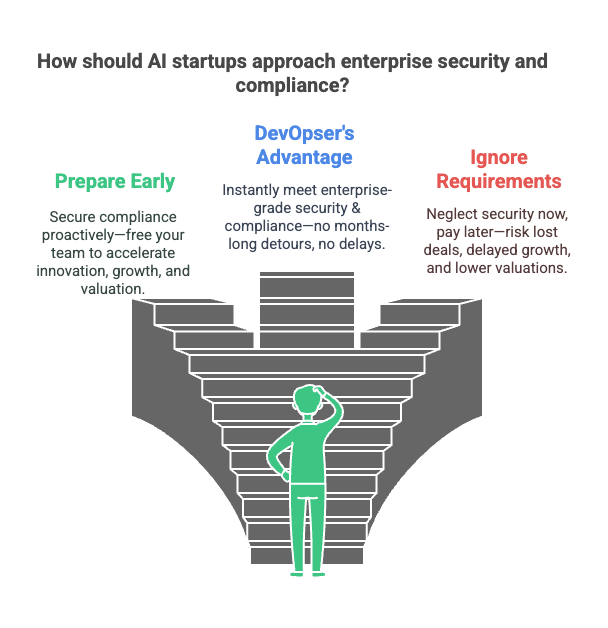
Rather than getting bogged down in security and compliance at the worst possible moment, AI startups should prepare in advance-allowing them to focus on product development, user growth, and investor returns.
Enter DevOpser: a secure AI DevOps solution that allows startups to meet enterprise security standards without wasting months on infrastructure and compliance efforts.
AI investors push startups toward rapid innovation and aggressive growth, racing toward a lucrative acquisition. Yet, many founders discover-often too late-that hidden enterprise security requirements can quietly sabotage deals. When an interested buyer suddenly cools off, it's usually because underlying security and compliance weaknesses become apparent during diligence via tools such as SecurityScorecard or SecurityHeaders.
Common Hidden Risks:
Growth attracts attention, but robust security and compliance secure the acquisition.
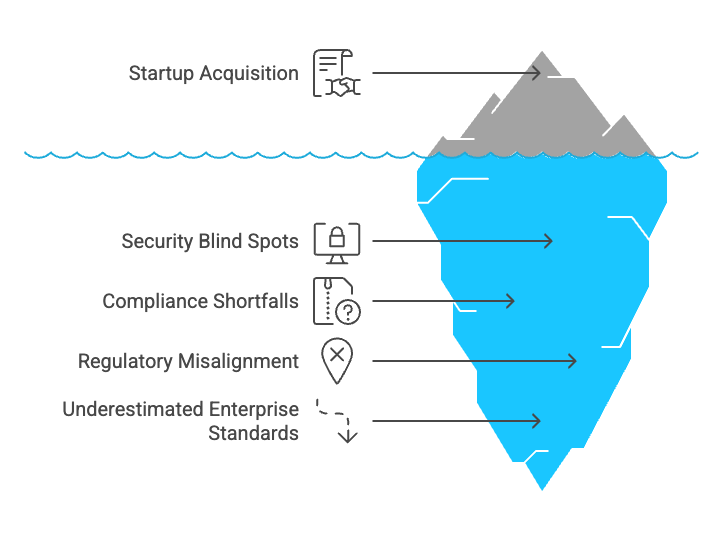
Large enterprises have non-negotiable security and compliance standards, often mandated for legal and operational reasons.
Key barriers startups must address before acquisition:
Conclusion:
Startups that fall short of these stringent security and compliance requirements risk delayed deals, heightened scrutiny, or reduced acquisition valuations. DevOpser's platform is built entirely on secure Infrastructure as Code, specifically leveraging our battle-tested, secure Terraform-powered IaC Platform for NIST CSF Compliant EKS. With DevOpser, startups confidently provide comprehensive documentation, meet enterprise-grade diligence demands, and stand out from competing acquisition candidates.
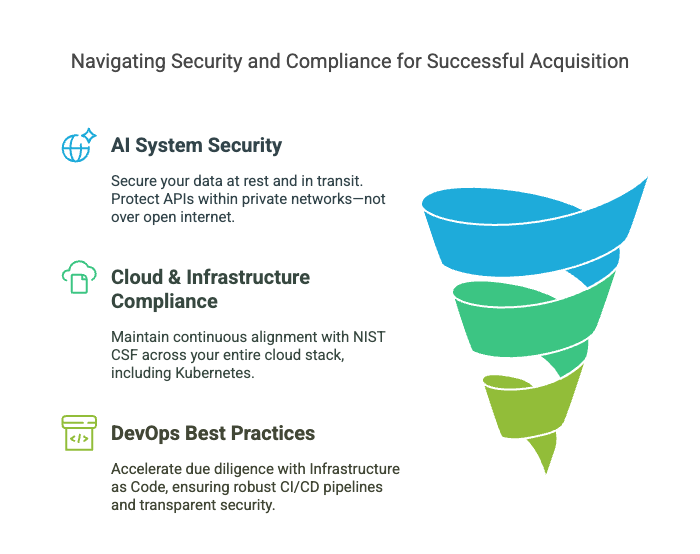
If a partner builds or runs your infrastructure, its choices become your audit evidence. Judge partners on these criteria:
DevOpser's platform is built to align with the NIST Cybersecurity Framework. Alignment is not a certification, though: if your buyers ask for a SOC 2 report or an ISO certificate, your company still needs its own.
Instead of losing months scrambling to address enterprise security and compliance demands, AI startups can leverage DevOpser from day one to build security-first infrastructure effortlessly.
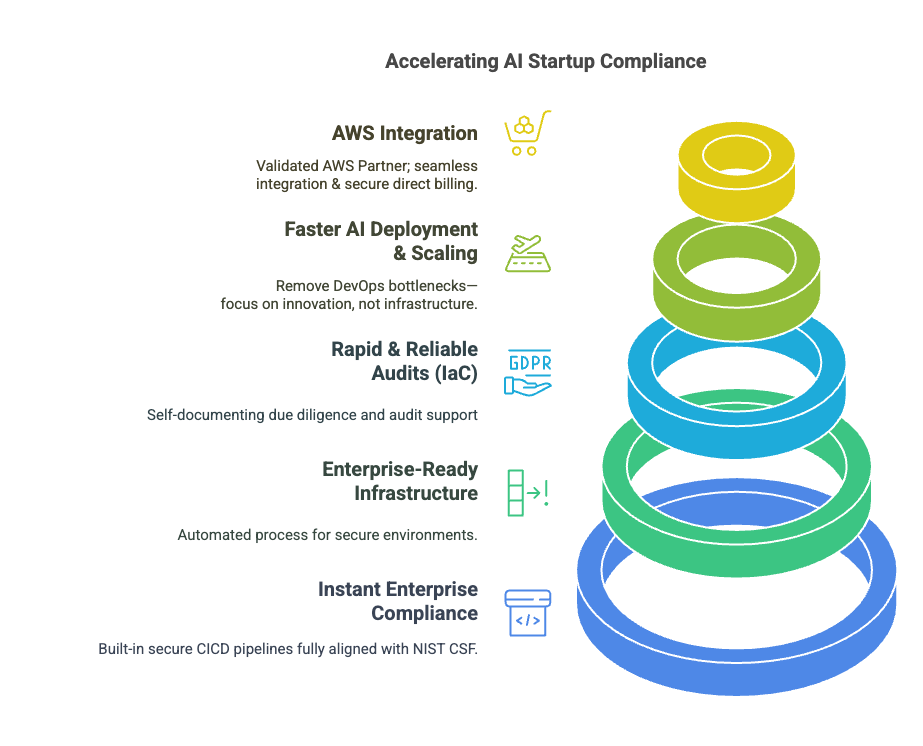
How DevOpser Accelerates Security & Compliance for Startups:
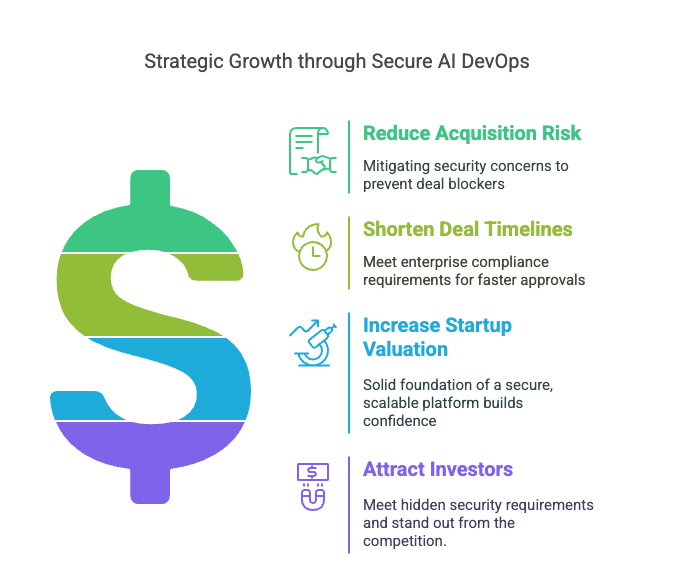
Leveraging DevOpser empowers AI startups to effortlessly address enterprise security concerns, streamline compliance processes, and accelerate readiness for acquisition-keeping them laser-focused on their core mission.
Security and compliance aren't just checkboxes-they're growth enablers.
A robust, compliant AI infrastructure isn't just a technical achievement-it's a strategic asset that dramatically elevates your company's valuation and transforms acquisition negotiations from defensive explanations to confident demonstrations of enterprise readiness.
Start with a SOC 2 Type II report, which US buyers ask for most, or ISO/IEC 27001 certification, which is common internationally. Add a HIPAA Business Associate Agreement for healthcare, PCI DSS if you handle card payments, FedRAMP for US federal agencies and GDPR terms for personal data from the EU. ISO/IEC 42001 certification or alignment with the NIST AI Risk Management Framework shows how you govern the AI itself.
Get the one your target buyers ask for. US enterprise buyers most often request a SOC 2 Type II report, while buyers outside the US more often ask for ISO/IEC 27001. The underlying controls overlap heavily, so work done for one carries over to the other.
Ask for current audit reports or certificates, then review what certifications don't fully cover: SSO and MFA, encryption, data retention, whether customer data trains models, audit logs, recent penetration test results, subprocessors including model providers, incident response and data residency. Make sure the contract confirms the answers, not just the questionnaire.
Yes. Auditors assess your controls, not who or what wrote the code. AI-generated code needs the same safeguards as any other code: review, automated security scanning, testing in staging and secure defaults. Starting from a hardened template, instead of generating authentication and infrastructure from scratch, closes many common gaps.
Restaurant brands review voice-ordering and drive-thru AI vendors like other software suppliers, so expect requests for a SOC 2 Type II report or ISO/IEC 27001 certification. If the system takes payments, PCI DSS applies, and recorded customer audio raises privacy questions under laws such as GDPR. To know what a specific vendor meets, check its trust center or ask for its reports.
No. The NIST Cybersecurity Framework is voluntary guidance with no certification program. Alignment shows your controls follow its structure, which helps with questionnaires and audits, but it does not replace a SOC 2 report or an ISO/IEC 27001 certificate when a buyer asks for one.
For AI startups, the road to enterprise acquisition is filled with security and compliance challenges that can make or break a deal.
DevOpser eliminates these roadblocks, allowing startups to:
Don't let security kill your deal. Stay acquisition-ready with DevOpser's secure AI DevOps platform-available now on the AWS Marketplace.
Ready to secure your AI startup for acquisition?
Discover DevOpser on the AWS Marketplace