
What Is CI/CD Compliance?
Regulations and security frameworks rarely mention CI/CD by name. They require change management, access control, audit logging and secure configuration. Your pipeline is where every code and infrastructure change reaches production, which makes it the most reliable place to enforce those requirements and collect proof that you met them.
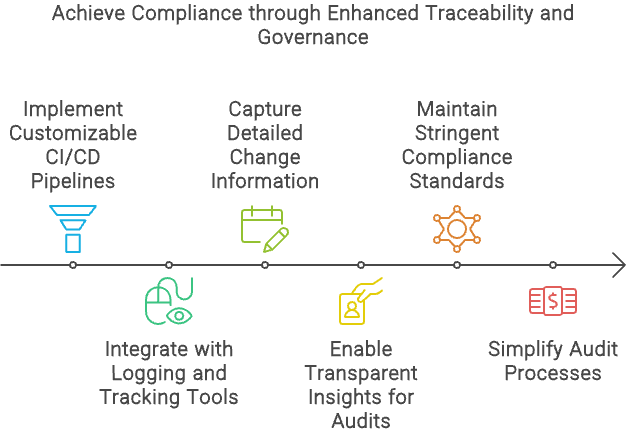
Without a compliant pipeline, teams rebuild evidence by hand before each audit. With one, the pipeline blocks changes that skip a required step and keeps the record as a by-product of normal work. Running these checks on every change, not once a year, is what a continuous compliance pipeline means.

Key Takeaway: A compliant pipeline does not rely on people remembering the process. It enforces the process and produces the audit trail as it runs.
The Controls a Compliant CI/CD Pipeline Enforces
Most frameworks expect the same core controls from software delivery. A compliant pipeline enforces each one in code:
- Approvals and separation of duties: Protected branches and required pull request reviews stop anyone from merging their own change to production without a second person's approval.
- Audit trails: Every commit, review, build and deployment is logged with who did it and when, in logs the people making changes cannot alter.
- Change records: Each release traces back to a pull request that shows what changed, why, who approved it and which checks passed.
- Artifact provenance: The pipeline builds each artifact, such as a container image, from a known commit and stores it in a registry. Many teams also sign images and publish a software bill of materials (SBOM).
- Policy-as-code checks on infrastructure: Infrastructure is defined in code, such as Terraform, and checked against security policy before it is applied. Drift detection flags changes made outside the pipeline.
- Secrets management: Credentials live in a secrets manager, scoped to each environment and injected at runtime. They are never committed to a repository.
- Automated security testing: Code, dependency and container scans run on every change and catch known issues before release.
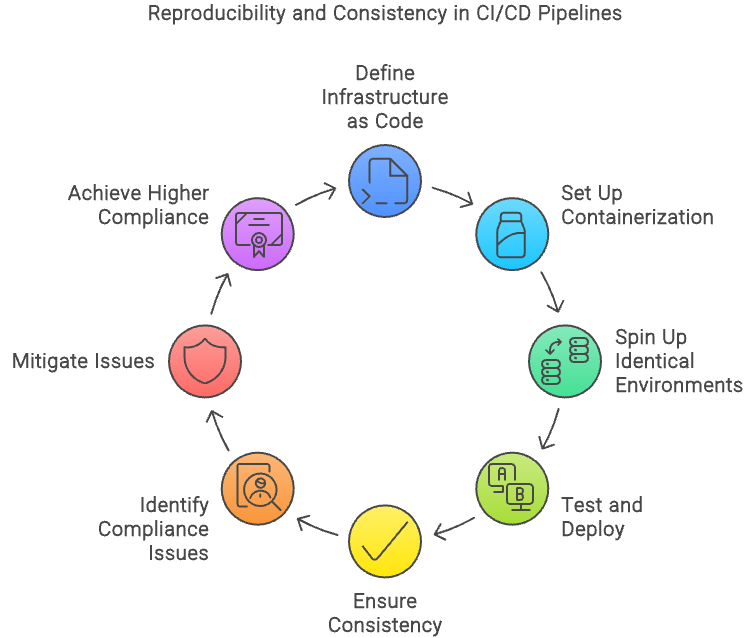
- Reproducible environments: Development, staging and production are built from the same code, so what you tested is what you run.
Production-Like Test Environments on Demand
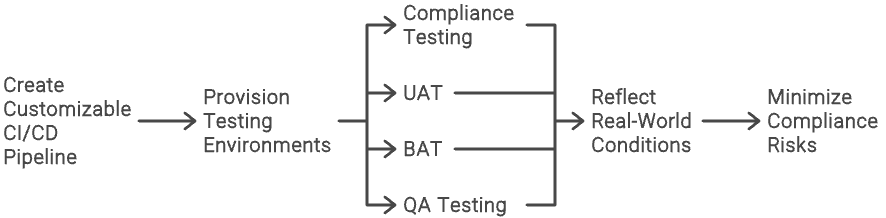
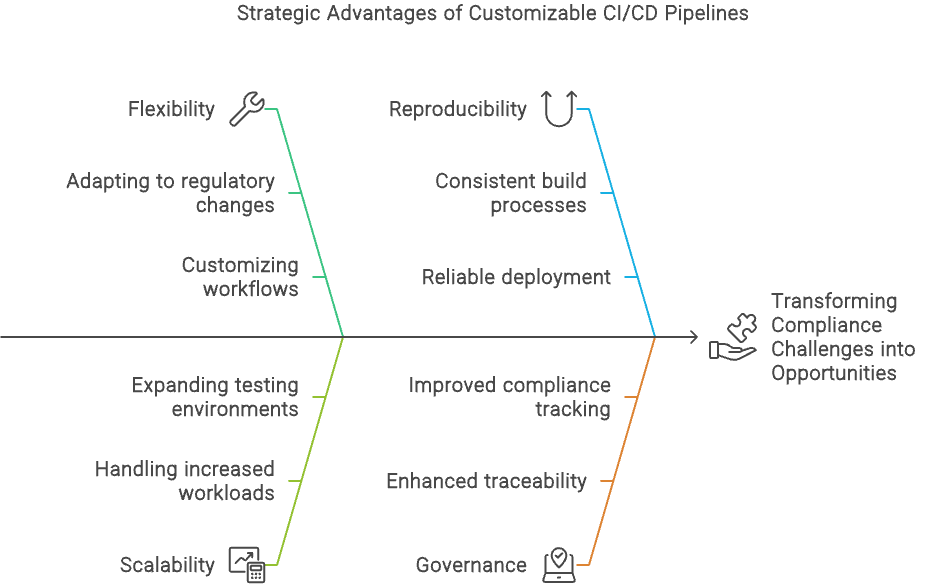
Compliance testing, user acceptance testing (UAT), business acceptance testing (BAT) and QA all need environments that behave like production. A pipeline built on Infrastructure as Code (IaC) and containers creates identical environments for each stage, so you catch compliance issues before they reach your live product.
Key Takeaway: Consistent environments mean fewer surprises in production.
CI/CD Governance: Who Can Change What, and How You Prove It
CI/CD governance is the set of rules for how changes move through your pipeline, plus the records that show those rules are followed. It answers four questions auditors ask:
- Who can approve a change? Define reviewers for each repository and environment, and require stricter approval for production.
- Which checks are mandatory? Make tests, scans and policy checks required, so no one can skip them.
- Who can change the pipeline itself? Keep pipeline definitions in version control, review them like application code and restrict access to deployment credentials.
- How are exceptions handled? Document an emergency change path, log every use of it and review each one afterward.
When every team ships through the same approved templates, you review one pattern instead of dozens. An internal developer platform provides those templates.
Key Takeaway: Good governance shows who changed what, when and why, without anyone assembling that record by hand.
CI/CD for Regulated Industries
No framework certifies a pipeline on its own. Each defines controls your organization must operate and prove, and a well-built pipeline produces much of that proof. Your auditor or assessor decides how your controls map to each requirement.
Healthcare: HIPAA
The HIPAA Security Rule requires technical safeguards for systems that handle electronic protected health information (ePHI): access controls, audit controls, integrity controls, person or entity authentication and transmission security. In a pipeline, that usually means restricted, logged access to production, reviewed changes, encryption in transit and no real patient data in test environments. Vendors that create, receive, maintain or transmit PHI for you must sign a business associate agreement (BAA). There is no HIPAA certification recognized by HHS.
Finance and Payments: SOC 2 and PCI DSS
SOC 2 is an attestation report issued by an independent CPA firm against the AICPA Trust Services Criteria. Its change management criteria expect changes to be authorized, tested, approved and documented before release, and its logical access criteria cover who can deploy. PCI DSS applies wherever payment card data is stored, processed or transmitted. Requirement 6 covers secure software development and change control, including separating pre-production from production, and Requirement 10 covers logging and monitoring access.
Public Sector: NIST SP 800-53 and FedRAMP
NIST SP 800-53 is the security control catalog for U.S. federal information systems. Its Configuration Management family includes baseline configuration and configuration change control, Access Control includes separation of duties, and Audit and Accountability covers event logging. FedRAMP governs how cloud services are assessed and authorized for federal agency use, with baselines built on NIST SP 800-53. Agencies also ask software producers to attest to secure development practices based on NIST SP 800-218, the Secure Software Development Framework (SSDF).
Any Industry: NIST Cybersecurity Framework
The NIST Cybersecurity Framework (CSF) organizes security outcomes into six functions: Govern, Identify, Protect, Detect, Respond and Recover. It is voluntary and used across industries. A compliant pipeline directly supports Protect and Detect outcomes such as access control, secure configuration and continuous monitoring. DevOpser builds its platform to the NIST CSF.
How to Choose a CI/CD Compliance Platform or Company
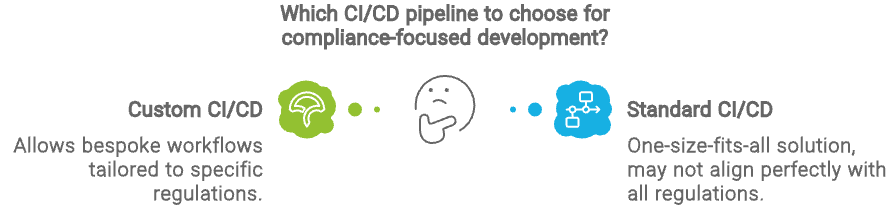
CI/CD compliance tools come in layers: source control with branch protection, a CI system, Infrastructure as Code, policy engines such as HashiCorp Sentinel or OPA Gatekeeper, a secrets manager and security scanners. The hard part is wiring them into one pipeline that enforces your controls. When you compare CI/CD compliance solutions, look for:
- Enforcement, not reminders: Required controls block a release when they fail. A dashboard that reports violations after deployment is not enough.
- Evidence on demand: You can show an auditor the approval, checks and deployment record for any release without rebuilding it by hand.
- Infrastructure in scope: The platform governs infrastructure changes as well as application code, and it detects drift.
- Fit with your stack: It works with your source control, cloud accounts and existing pipelines instead of forcing a rebuild.
- Clear shared responsibility: The provider states which controls it operates and which stay with you, and it signs a BAA or shares its security documentation when your framework requires it.
- Ownership: Your pipeline and infrastructure code stay usable if you change providers.
How DevOpser Builds Compliance into CI/CD
DevOpser delivers the pipeline and the AWS infrastructure it deploys to as one Terraform-powered platform, built to the NIST Cybersecurity Framework. It includes:
- GitOps promotion: Each application has development, staging and main (production) branches. Changes move from a feature branch to staging to production through pull requests, with branch protection, required reviews and automated security scanning. See the GitOps deployment guide.
- Container builds on merge: Merging a pull request starts a GitHub Actions build that packages your app as a container image, pushes it to the container registry and triggers the redeploy. The promoting changes guide shows each step.
- Independent environments: Staging and production run separately. You can destroy and rebuild either one from a clean state without affecting the other.
- Policy as code for infrastructure: Security requirements are written into the Terraform code, each layer of the stack runs in its own Terraform Cloud workspace, and configuration drift is detected automatically. Read Policy as Code: Making Security Achievable.
- Hardened runtime: Applications run on Amazon EKS with Kubernetes Pod Security Admission policies, gVisor container isolation and AWS Secrets Manager for environment-specific secrets. The platform technical specifications list every component.
- Tailored to you: The IaC meets about 80% of common security requirements out of the box. We customize the last mile for your business, can deploy into your existing VPC and work with your auditors during due diligence.
Key Takeaway: With DevOpser, the controls auditors ask about run inside the pipeline and infrastructure code, so compliance happens as you ship, not before each audit.
CI/CD Compliance FAQ
What is CI/CD compliance?
CI/CD compliance is the practice of enforcing regulatory and security controls inside your build and deployment pipeline, such as approvals, audit logging, secrets management and policy checks, so every release meets them and leaves evidence behind.
What is CI/CD governance?
CI/CD governance is the set of rules that decide who can approve and deploy changes, which checks are mandatory and who can modify the pipeline, together with the records that prove those rules were followed.
What CI/CD platforms work for healthcare compliance?
HIPAA does not approve specific tools. A CI/CD platform works for healthcare when it supports access controls, audit logs, reviewed changes and encryption in transit, and when the vendor will sign a business associate agreement (BAA) if it handles protected health information.
Can a CI/CD pipeline make us SOC 2 or PCI DSS compliant?
No tool makes an organization compliant by itself. A compliant pipeline enforces many of the change management, access and logging controls these frameworks test and produces the evidence your auditor reviews. You still need policies and the rest of your control environment.
What is a continuous compliance pipeline?
A continuous compliance pipeline checks every change against your controls automatically, using tests, security scans and policy-as-code rules, instead of reviewing compliance once before an audit. Changes that fail a required check do not reach production.
What tools do you need for CI/CD compliance?
Most teams combine source control with branch protection, a CI system, Infrastructure as Code such as Terraform, policy checks, a secrets manager and security scanners. DevOpser combines GitHub, GitHub Actions, Terraform Cloud and AWS Secrets Manager into one GitOps pipeline on AWS.
Does DevOpser work with our existing AWS environment?
Yes. DevOpser has versions of its Terraform platform that deploy into an existing VPC and integrate with your existing VPN, and the team tailors the last mile of security controls to your requirements.
Ready to Build a Compliant CI/CD Pipeline?
Tell us which frameworks you answer to and how you ship today, and we will show you how DevOpser's pipeline and infrastructure fit. Contact us or book a demo.